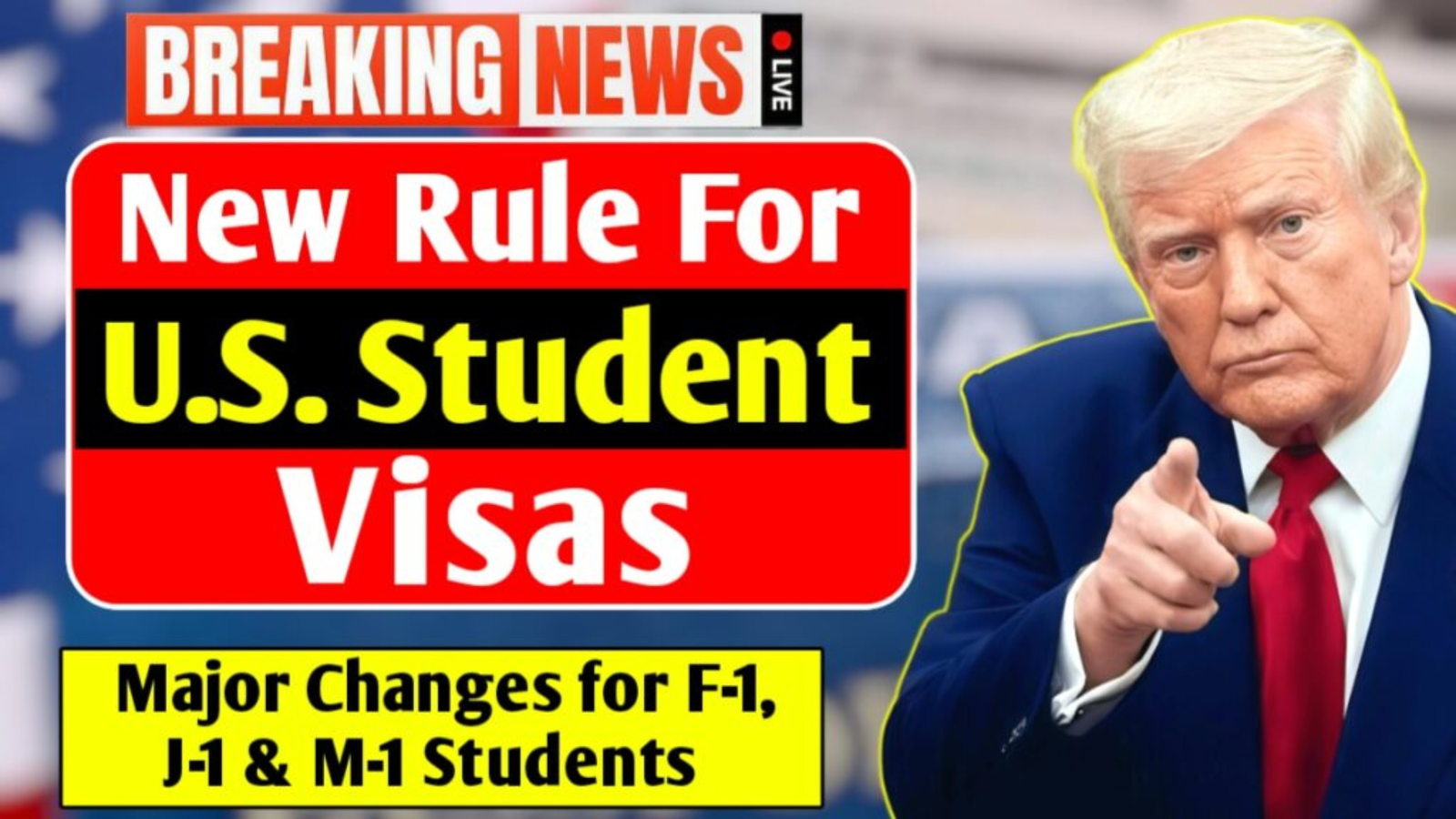
In a bold move that’s sending ripples through international education circles, President Trump has unveiled sweeping new student visa changes 2025 that could redefine opportunities for aspiring scholars worldwide.
Announced via the Department of Homeland Security’s mid-November regulatory agenda, these reforms target F-1 academic students, J-1 exchange visitors, and M-1 vocational trainees, replacing the flexible “duration of status” with a strict four-year cap and heightened scrutiny to combat what officials describe as visa abuse and overstays.
As global talent flocks to U.S. campuses for world-class degrees and cultural immersion, understanding these Trump student visa changes is essential—whether you’re a high school senior dreaming of Ivy League halls or a professional eyeing a J-1 research fellowship. This in-depth guide unpacks the F-1 visa changes 2025, eligibility tweaks for J-1 and M-1 categories, and practical steps to navigate the shifting landscape, ensuring your path to American innovation remains viable amid tighter controls.
The Backstory: Why Trump Is Overhauling US Student Visas in 2025
The roots of these new rules for US student visas trace back to Trump’s first term, where early proposals in 2017 aimed to impose time limits on F-1 stays but faced pushback from universities and business lobbies. Fast-forward to 2025: With immigration enforcement ramped up post-inauguration, the administration revived the idea through a Federal Register notice, framing it as a national security imperative.
Citing over 2,100 legacy F-1 overstays from 2000-2010 still lingering in the system, DHS argues the indefinite “duration of status” enables fraud, from ghost enrollments to unauthorized work. Public comments closed in late September, and while finalization looms by early 2026, early adopters could feel the pinch sooner.
This isn’t just red tape—it’s a recalibration prioritizing U.S. worker protection and border integrity, layered atop expanded travel bans now covering 19 nations like Iran and Venezuela.
For the 1.1 million international students contributing $45 billion annually to the economy, the stakes are high: Will these student visa reforms 2025 stifle innovation or safeguard it? Experts predict a 10-15% dip in applications from high-volume countries like India and China, but savvy applicants can adapt by front-loading credentials and eyeing alternatives like O-1 visas for exceptional talent.
Breaking Down F-1 Visa Changes 2025: What Academic Students Need to Know
At the heart of Trump’s new rule for US student visas lies the F-1 overhaul, ditching unlimited stays tied to enrollment for a hard four-year ceiling, regardless of your program’s length—think PhDs spanning seven years now needing mid-stream extensions. This shift demands proactive planning, as extensions via USCIS will trigger deeper reviews of academic progress, financials, and intent to depart.
Key F-1 visa changes 2025 include:
- Fixed Four-Year Limit: Initial admission caps at your program’s expected duration, maxing at 48 months—post-grad OPT (up to 36 months for STEM) counts toward this, squeezing timelines for job hunts.
- Stricter Grace Period: Down from 60 days to 30 post-completion, leaving less buffer for H-1B transitions or packing up—factor in processing delays for added stress.
- Enhanced Vetting: Mandatory social media checks and biometrics for renewals, plus bans on dual intent (hinting at green cards) to enforce temporary stays.
For undergrads, the hit is milder, but grad students in fields like medicine or engineering may pivot to shorter tracks or domestic alternatives. Pro tip: Build a rock-solid I-20 early, documenting ties abroad to ace interviews.
J-1 Visa Reforms: Tighter Leashes for Exchange Visitors and Scholars
J-1 visas, the go-to for au pairs, researchers, and cultural envoys since the 1940s, aren’t escaping unscathed in these Trump student visa changes. The four-year cap applies here too, aligning stays with program specifics but capping extensions at DHS’s discretion—gone are the days of seamless rollovers for multi-year fellowships. Sponsors like universities must now report quarterly, amplifying compliance for everyone from Fulbright scholars to summer interns.
Impacts on J-1 eligibility 2025 break down as:
- Program-Aligned Caps: Up to four years max, with au pairs limited to 24 months and trainees to 18—extensions require proving unique value to U.S. interests.
- Reduced Grace Periods: A uniform 30-day window post-program, challenging for scholars awaiting publications or job leads before the two-year home residency rule kicks in.
- Travel Ban Overlaps: Nationals from the 19 restricted countries face outright denials, hitting J-1 exchanges from the Middle East and Latin America hardest.
Cultural programs might see enrollment drops of 20%, but advocates push for waivers. If J-1’s your lane, lock in sponsor letters early and explore hybrid remote options to hedge bets.
M-1 Visa Updates: Vocational Training Faces New Hurdles
Less flashy than F-1 or J-1, M-1 visas for vocational pursuits—like culinary arts or aviation mechanics—get a pragmatic tweak under the new rules, with the four-year ceiling tailored to hands-on timelines but demanding rigorous program verification. No OPT equivalent exists here, so the shorter grace period amplifies urgency for trade school grads eyeing work visas.
Notable M-1 changes in 2025:
- Duration Tied to Training: Max four years, but shorter for certificate programs—extensions hinge on completion proof and no U.S. job intent.
- Grace Period Slash: 30 days to wrap up and exit, pressuring students in accelerated courses without built-in buffers.
- Fraud-Focused Scrutiny: Heightened checks on school legitimacy, targeting “pay-to-stay” schemes in for-profit vocational hubs.
This could sideline 5,000+ applicants yearly, per trade associations, but boosts legit programs’ prestige. Aspiring chefs or tech trainees: Vet schools via SEVP and prep backup plans like Canada’s skilled worker paths.
How to Prepare for Student Visa Eligibility 2025: Actionable Steps
With these reforms in flux, fortifying your application is non-negotiable. Start by consulting ICE’s SEVIS portal for real-time updates, then:
- Document Everything: Amass proof of funds, academic merit, and home ties—anticipate social media dives via privacy audits.
- Time Extensions Wisely: File Form I-539 six months pre-expiry, budgeting $470 fees and 4-6 month waits.
- Explore Alternatives: O-1 for prodigies or H-1B wage-based lotteries offer lifelines; consider U.K. or Australia for seamless transitions.
- Seek Expert Guidance: Enroll with NAFSA-accredited advisors—avoid scams promising “guaranteed approvals.”
Harvard’s recent J-1 probe underscores institutional risks, so choose SEVP-certified schools. These steps turn uncertainty into strategy.
The Bigger Picture: Impacts and What’s Next for International Education
Trump’s new rule for US student visas could reshape campuses, curbing diversity while funneling talent to compliant powerhouses—expect enrollment dips of 100,000+ across categories, per IIE forecasts. Yet, it bolsters security, potentially weeding out fraud to benefit genuine innovators. Beyond 2025, watch for H-1B synergies and lawsuit challenges from AASCU. For now, resilience rules: Adapt, document, and diversify.