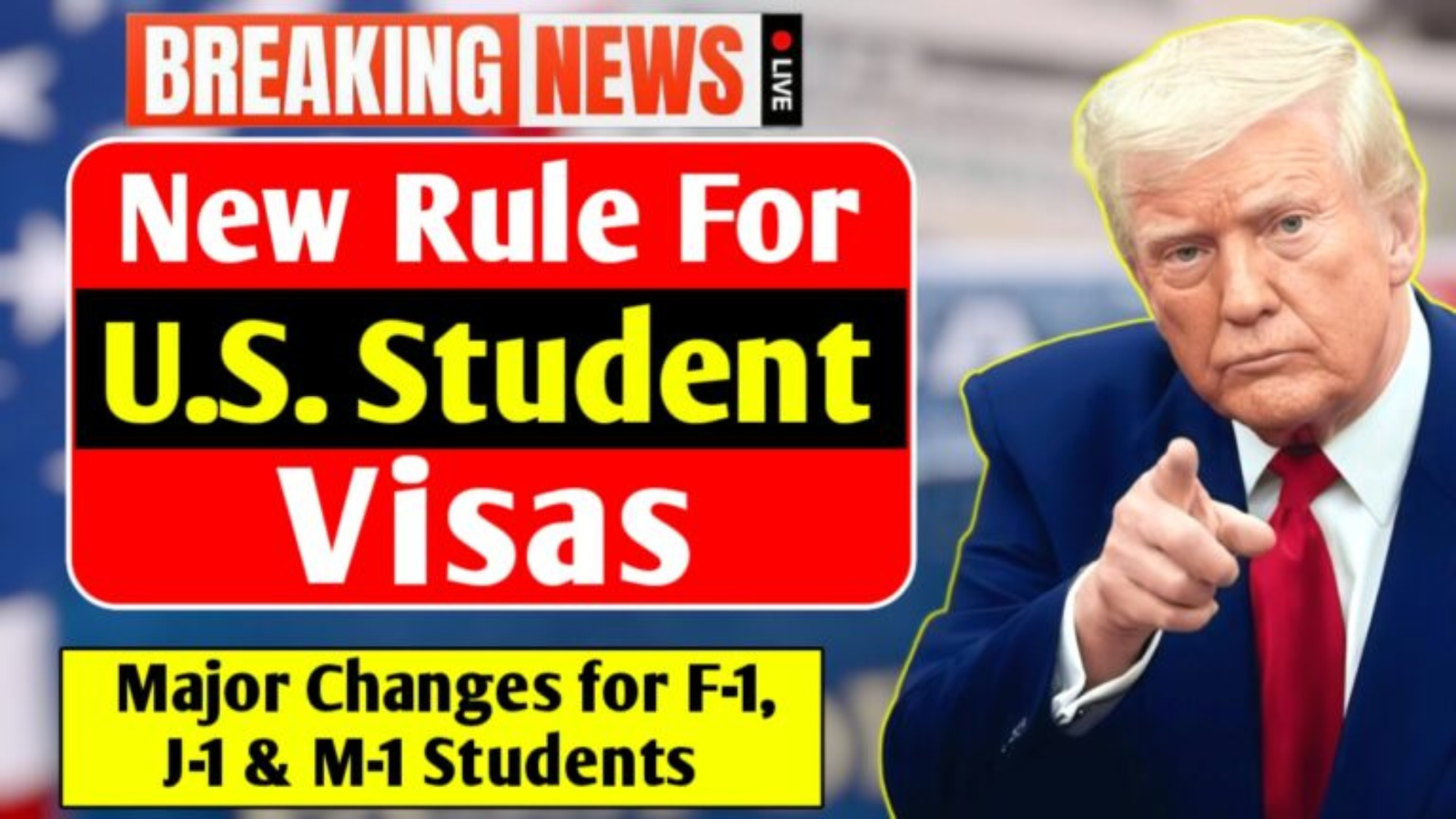
In a sweeping immigration policy shift that’s sending shockwaves through global academic circles, President Trump has announced a proposed overhaul of new rule for US student visas, targeting F-1 visa changes 2025, J-1 visa updates 2025, and M-1 student visa reforms to address what the administration deems chronic “visa abuse” and national security gaps.
Unveiled via the Department of Homeland Security’s (DHS) regulatory agenda in mid-November 2025, these Trump student visa changes replace the longstanding “duration of status” (DOS) flexibility—allowing indefinite stays linked to enrollment—with rigid four-year caps, mandatory extensions, and intensified vetting for over 1.1 million international students annually.
If you’re an aspiring F-1 undergrad from India, a J-1 researcher from Europe, or an M-1 vocational trainee eyeing U.S. flight schools, these reforms could upend your plans amid already declining arrivals (down 50% for Indian students in July 2025 alone). This in-depth analysis explores the US student visa overhaul 2025, from core eligibility shifts to implementation timelines and adaptation strategies—helping you stay ahead in a landscape where opportunity meets oversight.
Why Trump Is Pushing New Rules for US Student Visas in 2025: Security, Fraud, and Economic Priorities
The new rule for US student visas emerges from the Trump administration’s intensified immigration agenda, reviving first-term efforts to curb perceived abuses in nonimmigrant programs amid rising concerns over overstays and labor displacement.
DHS data highlights over 2,100 F-1 entrants from 2000-2010 still in status as of April 2025, fueling arguments for fixed timelines over DOS, which critics say enables indefinite stays without re-vetting. Announced November 15, 2025, the proposal—open for public comments until December 15—seeks to cap F-1, J-1, and M-1 stays at four years maximum, program duration notwithstanding, with extensions requiring USCIS biometric reviews and compliance proofs.
At stake? The U.S.’s $45 billion international education economy, already strained by 2025’s 20% enrollment drop from China and India. Proponents tout enhanced security and job protection; opponents, including NAFSA and AICE, warn of brain drain to Canada and Australia, projecting $5-10 billion in lost university revenue. Finalization eyed for Q1 2026 means current applicants (pre-March) may grandfather under old rules, but extensions won’t—urging immediate planning for those in pipeline.
F-1 Visa Changes 2025: Fixed Stays and Tighter OPT/CPT for Academic Students
The F-1 visa changes 2025 strike at the heart of academic flexibility, ditching DOS for a hard four-year cap on initial admissions for undergrads, grads, and PhDs—regardless of program length—forcing extensions with USCIS proof of enrollment, finances, and no red flags. Affecting 800,000+ F-1 holders yearly (top from China/India), this limits long-haul pursuits like medicine (8+ years) without repeated approvals.
Impacts in focus:
- Grace Period Cuts: Post-grad OPT stays 12 months (36 for STEM), but the 60-day job hunt shrinks to 30—pressuring H-1B transitions amid 85% denial rates for Indians.
- Transfer Hurdles: School/major switches need pre-USCIS nods and advisor letters, curbing “shopping” but complicating dual majors or pivots.
- CPT Crackdown: Day 1 Curricular Practical Training faces audits; non-core work risks denials, hitting business/tech programs hard.
For F-1 hopefuls, fortify I-20s with ironclad timelines—schools like MIT now mandate visa workshops.
J-1 Visa Updates 2025: Shorter Timelines for Exchange Visitors and Scholars
Exchange programs take a hit under J-1 visa updates 2025, extending the four-year cap to au pairs, postdocs, and Fulbrights—ending indefinite research stays with sponsor-mandated biometric re-vettings and annual reports. The two-year home residency for funded J-1s persists, but all extensions demand DHS nods on U.S. job needs.
Critical shifts:
- Research Limits: PhD postdocs cap at four years; renewals tie to sponsor endorsements and market gaps—deterring 100,000+ annual participants.
- Au Pair/Trainee Caps: One-year basics intact, but multi-year like Teach USA total four years—squeezing family programs.
- Grace Squeeze: 30-day post-program window demands swift waivers or departures—plan meticulously.
These Trump student visa changes may redirect talent to EU exchanges; DS-2019 filers, strategize multi-phases early.
M-1 Student Visa Reforms: Vocational Training Under Stricter Scrutiny
Vocational paths get clipped in M-1 student visa reforms, aligning hands-on programs (e.g., aviation at Embry-Riddle or culinary at CIA) with four-year maxes, program-tailored but extension-heavy—ending DOS without USCIS financial/tie proofs.
Notable overhauls:
- Practical Training Caps: One-year post-study holds, but 30-day grace rushes employer hunts or exits.
- Program Audits: Short courses (<2 years) approve fully; add-ons like internships trigger “abuse” flags.
- Rejection Spikes: SEVIS gaps could hike denials—scrutinize I-20s.
M-1 aspirants, view the U.S. as premium, not perpetual—consider hybrids for bridges.
Ripple Effects of the New Rule for US Student Visas: OPT, H-1B, and Global Shifts
The new rule for US student visas cascades beyond stays: OPT delays under reviews complicate H-1B lotteries (now wage-prioritized, 85% Indian denials), while dependents lose perks on primary caps—universities brace for 20% enrollment dips. Timeline: Finals by March 2026; pre-January applicants grandfather—monitor DHS.gov or NAFSA.
Adapting to Trump Student Visa Changes: Actionable Advice for 2025 Applicants
Thriving amid US student visa overhaul 2025 demands agility—don’t panic, pivot.
- Apply ASAP: DS-160 six months early; stack $50K+ financials.
- Compliance Kit: SEVIS-approved schools; log 20-hour CPTs meticulously.
- Backup Blueprints: Canada’s SDS or UK’s PSW as Plan B.
- Expert Edge: EducationUSA free; attorneys for appeals ($500-2K).
Track Federal Register—these F-1 visa changes 2025 evolve rapidly.
Final Thoughts: Navigating the New Rule for US Student Visas in a Shifting Landscape
President Trump’s new rule for US student visas—capping F-1, J-1, and M-1 at four years with vetting ramps—ushers accountability but risks U.S. education’s allure, amid J-1 visa updates 2025 and beyond. For resilient students, it’s a prompt to plan sharper, not scrap dreams—2026 finals loom, but preparation prevails. Monitor DHS, consult pros, and build alternatives. Aiming stateside? Comment your strategy—we’re decoding together. For M-1 student visa reforms intel, subscribe and stay strategic.